Búsqueda avanzada
Buscar
 

Entra en BiblioEteca...

Disfruta de todo el potencial de biblioEteca entrando con tu usuario...


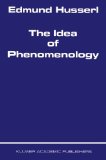
THE IDEA OF PHENOMENOLOGY


AUTOR: ; ND
 
 
  • Portada de THE IDEA OF PHENOMENOLOGY

    9789024701148

 
Compartir: Compartir con un amigo de biblioeteca Compartir por email Compartir en Facebook Compartir Twitter Compartir en Tuenti Capturar código QR Añadir RSS

Sinópsis del libro:

  • This translation is concluded in our Readings in Twentieth­ Century Philosophy, (N. Y. , The Free Press of Glencoe, Inc. , 1963). We owe thanks to Professors W. D. Falk and William Hughes for helping us with the
    translation. We also owe thanks to Professor Herbert Spiegelberg, Dr. Walter Biemel and the Husser! Archives at Louvain for checking it and we are especially indebted to Professor Dorion Cairns, many of whose suggestions we
    incorporated in the final draft. WILLIAM P. ALSTON GEORGE NAKHNIKIAN January 1964 CONTENTS V Preface Introduction IX The train of thoughts in the lectures I Lecture I 13 Lecture II 22 Lecture III 33 Lecture IV 43 Lecture V 52
    INTRODUCTION From April 26 to May 2, 1907, Husserl delivered five lectures in Gottingen. They introduce the main ideas of his later pheno­ menology, the one that goes beyond the phenomenology of the Logische Untersuchungen.
    These lectures and Husserl's summary of them entitled "The Train of Thoughts in the Lectures" were edited by Dr. Walter Biemel and first published in 1950 under the 1 title Die Idee der Phiinomenologie. Husserl wrote the
    summary on the night of the last lecture, not for formal delivery but for his own use. This accounts for the fact that the summary contains incomplete sentences. There are some discrepancies between Lecture V and the
    corresponding passages in the summary. We may suppose that the passages in the summary are a closer approximation to what Husserl wanted to say.

    Idioma: INGLÉS


Clasificador

Según nuestros usuarios

RIGUROSO
Riguroso

Determina lo preciso o impreciso que es este libro con respecto a lo que se cuenta en el mismo. 0 significa que es completamente impreciso y 10 que cuenta es rigurosamente verídico

Más información
DIVERTIDO
Divertido

Determina lo divertido que te ha resultado el libro: 0-aburrido 10-muy divertido

Más información
COMPLEJO
Complejo

Determinamos lo complejo que nos ha resultado la lectura del libro. Desde el nivel más bajo, que indica que es un texto secillo de comprender hasta el valor máximo que indica que es complejo de comprender

Más información
SORPRENDE
Sorprende

Indica lo sorprendente que resulta el argumento del libro, desde 0: previsible hasta 10: totalmente desconcertante y sorprendente

Más información


Etiquetas de otros usuarios

Así han etiquetado este libro más usuarios

Así han etiquetado otros usuarios este libro. Si ves acertada su elección puedes añadir la etiqueta con un simple clic a tus etiquetas



Comentarios de los lectores


Yo Leo

Información para lectores

Anillo de blogs

¿Tienes un blog?

Paga si te gusta

La forma de pago del futuro...

BiblioEtecarios

Ayudanos con los libros

Yo Escribo

Si eres autor, descubre más...

Ayuda

Todo lo que puedes hacer en la web
C/ Mayor, 50, 2C.
28921 Alcorcón (Madrid)
Tel/Fax : 91 288 73 76
E-mail : info@biblioeteca.com

BiblioEteca en Google Plus BiblioEteca en Rss

 
Copyright © 2026 BiblioEteca Technologies SL - Todos los derechos reservados